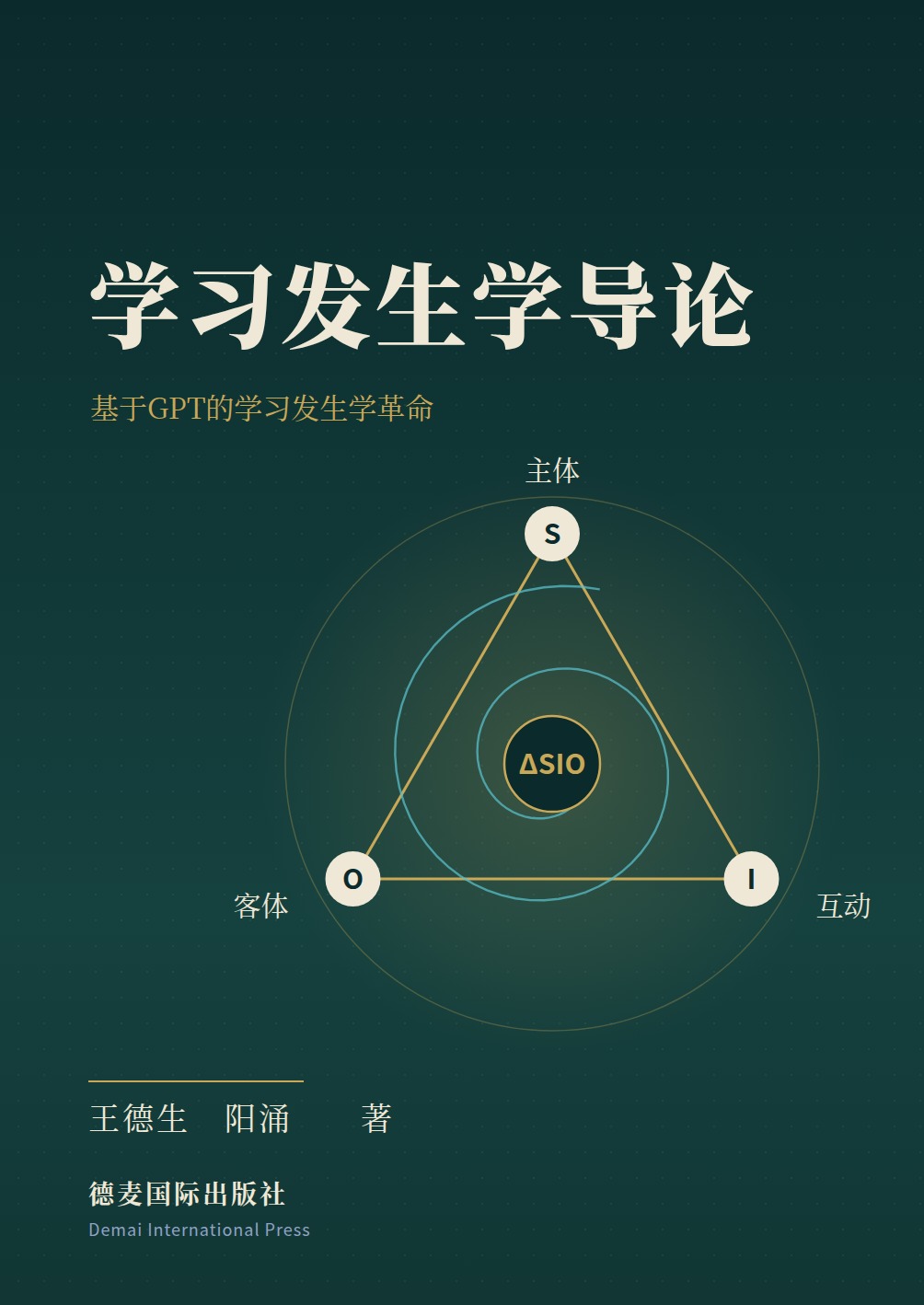
学习发生学导论
基于GPT的学习发生学革命 · Introduction to Learning Generativics
当 GPT 这样的生成式人工智能进入课堂,现代教育的地基正被悄然动摇:知识不再稀缺,作业可以在没有真正理解的情况下完成,传统评估难以把“学习”与单纯的“产出”区分开。本书不追问“如何更高效地学”,而追问一个更根本的问题——学习究竟是如何发生的?
作者把学习重新定义为主体—互动—客体(SIO)结构之内的意义生成:先拆解三大教学法的“空、乱、虚”、“传道授业解惑”的师道传统与“高分低能”的逻辑教育,一路追到苏格拉底的学习悖论;再以主体革命、机制革命、存在革命重建学习本体——真正的学习者是 SIO,特征律、自由律、幸福律协奏出知识、技术与艺术的学习,并提出“学习即纠缠”;最后落到学科 SIO 化、基于 GPT 的发生式教学五步模型,以及 GPT 时代教师、教材、学生的重生。GPT 不是学习的替代品,而是揭示、加速并追踪学习过程的催化剂。
三大革命
全书二十一章
| 章 | 题 | 所在 |
|---|---|---|
| 第 1 章 | 三大教学法的空、乱、虚 | 旧学习的解构 |
| 第 2 章 | “传道授业解惑”的当代缺陷 | 旧学习的解构 |
| 第 3 章 | 高分低能的终极解构 | 旧学习的解构 |
| 第 4 章 | 逻辑帝国与生成文明 | 旧学习的解构 |
| 第 5 章 | 学习如何可能 | 旧学习的解构 |
| 第 6 章 | 学习如何发生 | 旧学习的解构 |
| 第 7 章 | 学习的SIO本体论革命 | 学习本体的重构 |
| 第 8 章 | 学科知识的救赎 | 学习本体的重构 |
| 第 9 章 | 概念的SIO重生 | 学习本体的重构 |
| 第 10 章 | 主体革命 | 学习本体的重构 |
| 第 11 章 | 机制革命 | 学习本体的重构 |
| 第 12 章 | 存在革命 | 学习本体的重构 |
| 第 13 章 | 学习即纠缠 | 学习本体的重构 |
| 第 14 章 | 纠缠的展开 | 学习本体的重构 |
| 第 15 章 | 学科SIO化 | 基于GPT的学习发生学革命 |
| 第 16 章 | 学科SIO化的实践与路径 | 基于GPT的学习发生学革命 |
| 第 17 章 | 学科SIO化的未来与难点 | 基于GPT的学习发生学革命 |
| 第 18 章 | 基于GPT的学习发生学 | 基于GPT的学习发生学革命 |
| 第 19 章 | 发生式教学五步模型 | 基于GPT的学习发生学革命 |
| 第 20 章 | 教师、教材、学生的重生 | 基于GPT的学习发生学革命 |
| 第 21 章 | 制度与未来 | 基于GPT的学习发生学革命 |
作者简介
王德生,SDE(显露·差异序列·特征纠缠)本体论思想体系的创立者,德麦国际(新加坡)创始人、首席执行官。生长于中国农村,1990 年进入湘潭大学,后获中国科学院计算数学博士学位,曾在英国斯旺西大学与新加坡南洋理工大学工作。
阳涌,教育研究者、一线教育实践者,英语语言文学硕士,拥有 16 年基础教育教学、课程研发与学校管理经验。自 2019 年起跟随王德生博士学习其原创思想体系,构建了“AI+创新教育”体系,并持续开发小学与初中数学、英语及跨学科原创专著与教材。
编辑说明:本书由作者的书稿《论学习:基于GPT的学习发生学革命》(初稿)编成,初稿汇集作者 2024—2025 年写成的十二篇长文;出版沿用 ISBN 登记书名《学习发生学导论》。正文论断、例证与文风一仍其旧;编辑只做分编分章、标题分级、条目并段、表格复原、错字与标点修订、重复与公众号痕迹删除。
Book Description
As generative artificial intelligence such as GPT enters classrooms worldwide, the foundations of modern education are being quietly destabilized. Knowledge is no longer scarce, assignments can be completed without genuine understanding, and traditional assessments struggle to distinguish learning from mere output. In this context, Introduction to Learning Generativics does not ask how to learn more efficiently-it asks a far more fundamental question: how does learning actually happen? This book proposes Learning Generativics as a new foundational framework for understanding learning in the GPT era.
Moving beyond the dominant view of learning as knowledge acquisition, the authors redefine learning as a process of meaning generation within a Subject-Interaction-Object (SIO) structure. Learning, in this view, is not the accumulation of information or skills, but the emergence of structure through tension, interaction, rhythm, and reflection. Building on this ontology, the book advances three core shifts in educational thought: from isolated learners to integrated SIO systems; from outcome-driven performance to meaning dynamics governed by creativity, freedom, and well-being; and from transmission-based instruction to generative learning environments where structure is actively produced. A practical generative classroom model is introduced, demonstrating how GPT can function not as a substitute for learning, but as a catalyst that reveals, accelerates, and traces the learning process itself.
Rather than offering techniques or tools, Introduction to Learning Generativics reconstructs the philosophical foundations of learning for an age in which intelligence is no longer exclusively human. It argues that the future of education lies not in competing with artificial intelligence, but in reclaiming what machines cannot replace: the generation of meaning, structure, and self. This book serves as the foundational volume of the Learning Generativics series, opening a new path for educators, researchers, and thinkers seeking to reimagine learning as a generative force for individuals, institutions, and civilization itself.